Holter monitoring (24-hour ECG monitoring)
Holter monitoring is an important diagnostic method for detecting heart rhythm disorders and other cardiac problems that may not appear during a standard short ECG. During the study, a portable device is worn continuously for up to 48 hours, recording the heart’s activity. This gives the doctor a comprehensive picture of how the heart behaves in different situations and helps diagnose infrequent or transient rhythm disturbances.
When to see a specialist
- Palpitations or irregular heartbeat
- Dizziness or fainting
- Unexplained fatigue
- Chest pain of unclear origin
- Shortness of breath
- Heart rhythm disorders (arrhythmias) not detected on a standard ECG
- Coronary artery disease (impaired blood supply to the heart)
- Assessment of the effectiveness of cardiac medications
- Assessment of pacemaker function
Common symptoms
-
Chest Pain
Chest pain is a common symptom that can be a harmless muscle strain or a sign of a serious health condition, such as a heart attack. -
Chronic fatigue
If unexplained and persistent. -
Dizziness or fainting
Particularly if associated with physical activity. -
Episodic chest pain
If pain comes and goes and is not associated with physical exertion. -
Shortness of breath
During exertion, at rest, or when lying down. -
Suspected heart rhythm disorder
If a standard ECG has not provided sufficient information.
How to prepare for your appointment
- Take your usual medications unless your doctor has advised otherwise.
- Shower before coming in for the appointment, as you will not be able to shower while wearing the device.
- Wear loose, comfortable clothing that will not rub against the electrodes or the device.
- You will be given a diary in which to record all symptoms (e.g. palpitations, dizziness, chest pain), their onset and duration, and the activities you are engaged in during the monitoring period.
- Think through any questions you may have and raise them with your doctor before the procedure.
What to expect during your appointment
Reception
You will be welcomed and the procedure will be explained to you.
Electrode placement
Several electrodes are attached to your chest and connected to a small portable ECG recorder.
Wearing the device
The recorder is clipped to a belt or worn around the neck. You will carry it for 24 or 48 hours while going about your normal daily activities.
Keeping the diary
Throughout the monitoring period, you will record all symptoms and significant activities in the diary provided.
Device removal
Once the monitoring period is complete, you return to the clinic for the device and electrodes to be removed.
Data analysis
The recorded data is uploaded to a computer and analysed in detail by a cardiologist.
Feedback
We will share the results with you and, where needed, draw up a treatment plan.
Specialists providing this service
-
 dr Annely Toews
Cardiologist
Jalgpalli clinic, Rävala Clinic – Specialist Medical Care and Occupational Health
-
-
-
-
-
dr Marika Heinpalu-Kuum
Cardiologist
Rävala Clinic – Specialist Medical Care and Occupational Health
-
-
dr Silver Heinsar
resident cardiologist
Rävala Clinic – Specialist Medical Care and Occupational Health
-
dr Andreas Tulver
General practitioner
Rävala Clinic – Specialist Medical Care and Occupational Health, Pärnu Clinic, Ülemiste Health Centre, Mobile occupational health examination
-
dr Andrei Smõšljajev
General practitioner, General surgeon
Rävala Clinic – Specialist Medical Care and Occupational Health, Ülemiste Health Centre
-
dr Anna Verko
General practitioner
Jalgpalli clinic, Rävala Clinic – Specialist Medical Care and Occupational Health, Mobile occupational health examination
-
-
dr Eliise Koitla
General practitioner
Rävala Clinic – Specialist Medical Care and Occupational Health
-
-
dr Hanna-Liis Lett
General practitioner
Kvartal Clinic – Specialist Medical Care and Occupational Health, Digikliinik
-
dr Helen Palm
General practitioner
Jalgpalli clinic, Rävala Clinic – Specialist Medical Care and Occupational Health, Ülemiste Health Centre, Digikliinik
-
Henry Adusson
General Practitioner
Kvartal Clinic – Specialist Medical Care and Occupational Health, Põlva Treatment Office, Võru Treatment Office
-
dr Inga Tommer
General practitioner
Kvartal Clinic – Specialist Medical Care and Occupational Health, Põlva Treatment Office, Võru Treatment Office
-
-
-
dr Karmen-Birgit Kruustükk
General practitioner
Rävala Clinic – Specialist Medical Care and Occupational Health
-
dr Karoliine Teelahk
General Practitioner, Occupational Health Physician
Kvartal Clinic – Specialist Medical Care and Occupational Health, Põlva Treatment Office, Võru Treatment Office
-
dr Kerti Bobõlski
General practitioner
Rävala Clinic – Specialist Medical Care and Occupational Health, Ülemiste Health Centre
-
dr Ljudmilla Redko
General practitioner
Ülemiste Health Centre, Mobile occupational health examination
-
dr Maria Tabri
General practitioner
Pärnu Clinic, Ülemiste Health Centre, Mobile occupational health examination
-
-
-
-
dr Sandra Agur
General practitioner
Rävala Clinic – Specialist Medical Care and Occupational Health, Pärnu Clinic, Ülemiste Health Centre, Mobile occupational health examination, Digikliinik
-
-
dr Alexander Stefan Jankowski Rosendahl
Family doctor
Rävala Clinic – Specialist Medical Care and Occupational Health, Kvartal Clinic – Specialist Medical Care and Occupational Health, Põlva Treatment Office, Võru Treatment Office
-
dr Jekaterina Kolmakova
Family doctor, General surgeon
Jalgpalli clinic, Rävala Clinic – Specialist Medical Care and Occupational Health, Ülemiste Health Centre
-
-
-
-
































Payment & Appointment Info
Prices
Tallinn
| Service | Price |
|---|---|
| ECG monitoring – 24 hours The need for and suitability of the procedure will be assessed during a prior consultation with a specialist in Meliva, and the decision to proceed will be made jointly with the specialist. | 105 € |
| Electrocardiography (ECG) The need for and suitability of the procedure will be assessed during a prior consultation with a specialist in Meliva, and the decision to proceed will be made jointly with the specialist. | 23 € |
| ECG monitoring – 48 hours The need for and suitability of the procedure will be assessed during a prior consultation with a specialist in Meliva, and the decision to proceed will be made jointly with the specialist. | 119 € |
| ECG monitoring – 72 hours The need for and suitability of the procedure will be assessed during a prior consultation with a specialist in Meliva, and the decision to proceed will be made jointly with the specialist. | 139 € |
Everywhere else in Estonia
| Service | Price |
|---|---|
| ECG monitoring – 24 hours The need for and suitability of the procedure will be assessed during a prior consultation with a specialist in Meliva, and the decision to proceed will be made jointly with the specialist. | 105 € |
| Electrocardiography (ECG) The need for and suitability of the procedure will be assessed during a prior consultation with a specialist in Meliva, and the decision to proceed will be made jointly with the specialist. | 23 € |
| ECG monitoring – 48 hours The need for and suitability of the procedure will be assessed during a prior consultation with a specialist in Meliva, and the decision to proceed will be made jointly with the specialist. | 119 € |
| ECG monitoring – 72 hours The need for and suitability of the procedure will be assessed during a prior consultation with a specialist in Meliva, and the decision to proceed will be made jointly with the specialist. | 139 € |
Payment methods
With a doctor’s referral, Meliva Health Insurance covers this service under Outpatient Care coverage. Check your personal coverage limits in the ERGO app.
The service at Tartu Kvartal clinic is funded by the Health Insurance Fund based on a referral. To book an appointment funded by the Health Insurance Fund, please call +372 605 1500 or write to klienditugi@meliva.ee.
A visit fee may be added to the cost of treatment. Familiarize yourself with Meliva’s policy on charging visit fees.
Referral
A doctor’s referral is required to book this service.
Who is this appointment for?
Holter monitoring at Meliva is intended for diagnosing cardiac arrhythmias and other heart conditions in adults.
A doctor’s referral is required.
Holter monitoring is generally safe. The adhesive on the electrodes may cause mild and temporary skin irritation. The device must be kept dry. The examination is non-invasive and does not use ionising radiation.
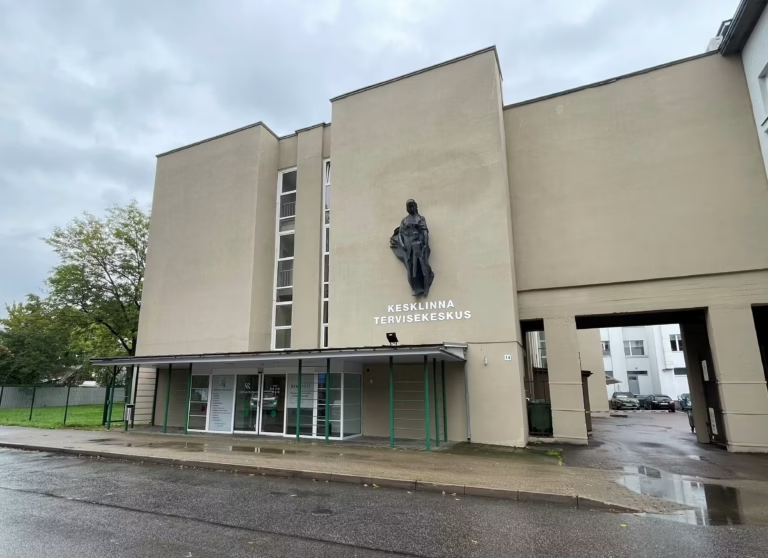
Clinics offering this service




Frequently Asked Questions
What is a Holter monitoring?
A Holter monitoring is an ECG monitoring that continuously records the heart’s electrical activity for 24 or 48 hours to detect arrhythmias and other heart problems.
Is a Holter monitoring painful?
No, Holter monitoring is a painless and safe procedure. The placement of electrodes may cause slight discomfort, but this is temporary.
What does Holter monitoring show?
Holter monitoring shows changes in heart rhythm and rate over 24 hours, detects arrhythmias, assesses myocardial blood supply, and evaluates the effectiveness of medications.
How long does Holter monitoring last?
Holter monitoring usually lasts 24 or 48 hours, during which you wear a portable ECG device.
Do I need a referral for Holter monitoring?
Yes, a doctor’s referral is required for Holter monitoring, as it is a specific diagnostic examination whose necessity is decided by the doctor.