What examinations are covered by Tervisekassa (the Estonian Health Insurance Fund) at Meliva?
As a contracted partner of Tervisekassa, Meliva offers patients access to a wide range of diagnostic examinations that are medically justified and require a referral.
What examinations are covered by Tervisekassa funding at Meliva?
Here’s an overview of which examinations are covered by Tervisekassa funding, which clinics offer them, and what exceptions to keep in mind.
X-ray diagnostics
This widely used imaging examination is available at the Meliva Jalgpalli, Rävala, Ülemiste Tervisemaja, and Tartu clinics. X-rays are essential for assessing the condition of bones and joints, helping diagnose fractures, joint conditions, or lung problems such as pneumonia. The examination is quick, and patients are typically referred by a family doctor or specialist when further diagnostic clarity is needed.
Ultrasound examinations
Ultrasound examinations, available at the Meliva Jalgpalli, Rävala, and Tartu clinics, are a safe, radiation-free method for assessing internal organs and soft tissue. They can be used to examine abdominal organs, the thyroid gland, blood vessels, and joints. Ultrasound is often the first diagnostic step in identifying the cause of pain, swelling, or other complaints, and the referral is made by a doctor based on the patient’s symptoms.
Cardiac ultrasound (echocardiography, or ECHO)
A specific type of ultrasound examination, performed at the Rävala and Tartu clinics. It allows assessment of the heart’s structure and function, including the condition of the heart valves, the performance of the heart muscle, and blood flow. This examination is needed in cases of heart failure, valve disorders, or unexplained shortness of breath, and is usually ordered by a cardiologist or family doctor.
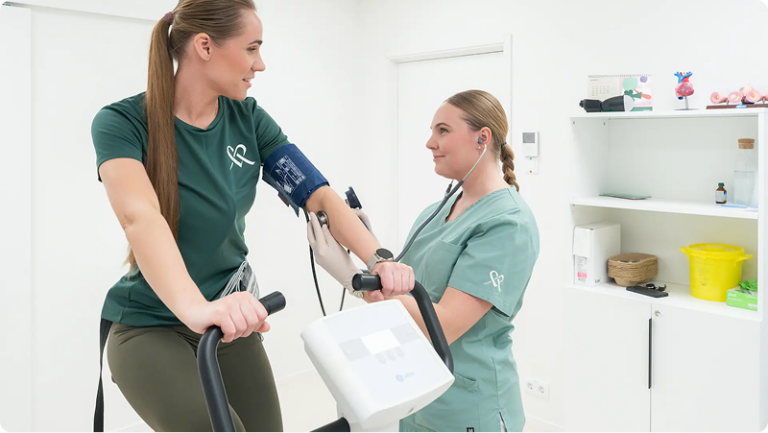
ECG stress test on a stationary bicycle
Available at the Jalgpalli, Rävala, Ülemiste Tervisemaja, and Tartu clinics, this examination assesses heart function under physical exertion. The patient cycles on a stationary bike while heart rhythm and blood pressure are monitored. It is important for evaluating the heart’s tolerance to exertion in cases of exercise-induced chest pain or suspected coronary artery disease. Referral is usually made by a doctor.
24-hour ECG monitoring (Holter monitoring)
Available at the Rävala and Tartu clinics, this examination tracks heart rhythm over a 24-hour period during normal daily activities. It helps detect rhythm disturbances that may not show up on a standard ECG and is useful for identifying the causes of heart palpitations, dizziness, or fainting. Referral is usually made by a family doctor or cardiologist.
Endoscopic examinations (colonoscopy, gastroscopy)
These examinations are available at Meliva’s Rävala clinic. Colonoscopy examines the large intestine, while gastroscopy examines the upper digestive tract (oesophagus, stomach, duodenum). They are needed in cases of abdominal pain, bleeding, anaemia, or suspected digestive tract conditions. Patients are referred by a family doctor or specialist, often a gastroenterologist.
Payment and waiting times
For services covered by Tervisekassa, patients typically only need to pay the standard visit fee. There are several ways for patients to confirm whether a specific examination or service at Meliva is covered by Tervisekassa funding.
It’s always worth contacting Meliva if you have a referral from your family doctor or another clinic for an examination or procedure.
The most accurate information on whether a specific service is funded by Tervisekassa or requires payment can be obtained from your family doctor. A family doctor can also refer patients to paid services, such as an MRI scan.
Relevant information on the specialties and services covered by the contract is available on both the Tervisekassa and Meliva websites.
It’s important to remember that not all examinations are automatically funded by Tervisekassa — they must be assessed by a doctor as medically justified and require a referral. It’s always worth checking with the referring family doctor whether an examination requires payment, as they can clarify whether the service is covered by Tervisekassa or must be paid for by the patient. Tervisekassa only funds services when the entire care pathway — from the doctor’s appointment to the examination — takes place within the Tervisekassa system.
Waiting times depend on the specific examination and the clinic’s current workload, and typically range from a few days to a month.