How does a stealthy tooth root infection give itself away?
Two-thirds of Estonians will experience a root infection at some point in their lives. Since it often develops without symptoms, regular dental check-ups are essential.

Siim, 27, discovered one day at the gym that pressing a barbell up from his chest triggered a sharp pain in his jaw. He’d noticed some discomfort on that side of his mouth before, but hadn’t considered it reason enough to see a dentist. With a holiday trip abroad coming up — to a country where dental care standards tend to be weaker — he decided to see a dentist before travelling. The dentist took an X-ray and found a root infection, which had started from an untreated cavity.
Few people have never experienced toothache. Sometimes, though, that pain can point to a fairly common dental issue: a root infection. A root infection generally develops from an untreated cavity.
“A root infection is caused by bacteria that damage the tooth’s nerve once a cavity has gone untreated. Microbes work their way through the cavity into the tooth pulp and travel down to the root tips, cutting off blood supply to the tooth — which then, in a sense, dies,” explains Dr Alissa Kolomiets, root canal specialist and head of treatment at Meliva’s Järve dental clinic. “A root infection can also develop as a result of trauma or untreated gum disease.”
It’s a fairly stealthy condition — we usually only notice the infection once it reaches its acute phase, when the pain becomes unbearable, eating with that tooth becomes impossible, or, in the worst cases, half the face swells up. With chronic pulp inflammation, clear symptoms may be absent, or they may be the kind that don’t seem serious enough to worry about.
What symptoms might point to a possible root infection?
- The infected tooth becomes highly sensitive to changes in temperature.
- The tooth may feel different from the others — as if it’s sitting slightly higher and more sensitive.
- Painkillers may ease the toothache for a while, but as the infection progresses, the pain becomes unbearable and no longer responds to painkillers.
- You may feel pressure pain when biting down, or be unable to eat with the affected tooth at all; the tooth may feel higher than the others.
- The tooth has darkened in colour over time.
- Swelling can develop in the gum next to the infected tooth, and in some cases, a pus-filled bump appears on the gum, occasionally releasing a foul-tasting fluid.
Kairi, 47, who has diligently visited the dentist every year in her small hometown, one day felt such severe pain while clenching her teeth that she suddenly couldn’t eat on that side of her mouth at all. Kairi managed to get an emergency appointment at a large dental clinic in the capital, where an X-ray was taken. Since her dentist back home didn’t have that kind of equipment, it turned out that a root infection had developed beneath the filling of a previously treated cavity, and the tooth needed treatment. “A chronically developing infection is identified through an X-ray,” explains Dr Kolomiets.
Long-untreated root infections can cause other health problems too
“A patient once came to my clinic who had already gone through three sinus surgeries before it was discovered that the underlying infection was actually coming from a tooth,” Dr Alissa Kolomiets describes a recent case. Certain cosmetic procedures — particularly ones involving heating of the skin, such as laser treatments — can also trigger a flare-up of a root infection. “I came across a case where a patient’s tooth had been sensitive for a few months, but not painful enough to warrant an immediate dentist visit. The pain suddenly flared up after laser treatment for pigmentation spots, and what started as an occasionally sensitive tooth turned into two weeks of sinus infection.”
Antibiotics and painkillers don’t work on a tooth with a root infection
The pulp is made up of connective tissue containing nerve fibres and blood vessels. In a necrotic, or dead, tooth, the pulp has been destroyed, and in a root-canal-treated tooth, it’s already been removed — meaning there’s no longer any blood supply reaching the root canal, so medications like antibiotics and painkillers simply can’t reach it.
“The longer a tooth stays in the mouth, the better — delaying implant placement, or replacing the tooth with an artificial one, is worth avoiding where possible. To be 100% certain that a tooth with a root infection truly can’t be saved, the patient is first referred to a root canal specialist,” Dr Kolomiets explains.
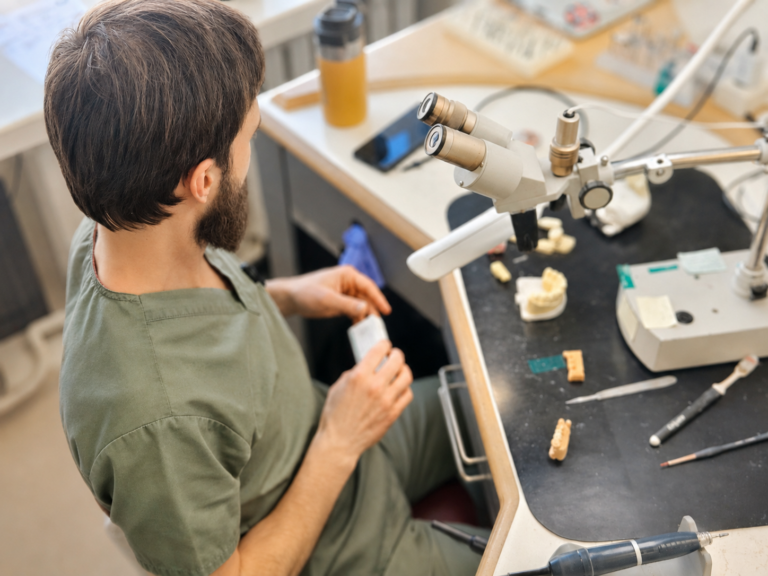
A microscope used in dental treatment helps a root canal specialist visualise the tooth’s root canals and see significantly deeper inside the tooth than is possible with the naked eye or magnifying loupes. A microscope also allows photos to be taken, which help explain the situation more clearly.
The doctor stresses that paying attention to daily oral hygiene is key to preventing root infections. Teeth should be brushed twice a day, and flossed before the evening brushing. A dentist should be visited at least once a year.
This story was first published on 8 February 2023 in Postimees.