Occupational health service providers and occupational physicians align on a shared vision in the context of the Ministry of Social Affairs’ developing strategy
On Friday, 20 March, representatives of the Estonian Association of Occupational Health Service Providers (ETTOL) and the Estonian Society of Occupational Health Physicians (ETTAS) met to map out shared development directions for the occupational health field, explore opportunities for cooperation, and analyse the sector's challenges and potential solutions.
The starting point was a shared goal among the state, physicians, and service providers: to keep the working-age population healthier and more capable of work, and to support people in staying in the labour market for as long as possible — recognising occupational health’s role as a systemic tool for prevention and early intervention within the healthcare system.
Ain Aaviksoo, Chairman of the Board of ETTOL, said that as the Ministry of Social Affairs has undertaken to modernise the national strategy for occupational health, professional associations are also ready to actively contribute to shaping the field’s development. “Estonia’s working-age population expects more from the healthcare system as a whole: earlier detection, faster intervention where needed, and assurance that no one is left to navigate their health concerns alone between different parties. We need to give people more opportunities and knowledge to take care of their own health, but we also need to create clarity about where and from whom people can get support when they need it — and confidence that the quality of the help on offer is trustworthy.”
ETTOL board member Ulla Ilisson noted that with around 160,000 people undergoing occupational health check-ups each year, this clearly represents one of the largest primary-level preventive measures in the country. “Estonians genuinely consider occupational health very important for maintaining their health. A Kantar Emor survey on Estonian residents’ satisfaction with occupational health shows that for many people, it even substitutes for regular health check-ups — particularly among men,” she said.
Jaanika Sass, Chair of the Estonian Society of Occupational Health Physicians, shared that occupational physicians are thoroughly trained specialists whose expertise could be put to far better use within Estonian healthcare than it currently is. “The great value of occupational health is that we often identify a person’s health risks before they seriously affect their day-to-day ability to work and their quality of life. If we give occupational health a stronger place within the healthcare system, the person benefits most of all — getting earlier attention for their health concerns and, where needed, faster ongoing support.”
Throughout the day, participants discussed several topics shaping the future of occupational health, including its role within the wider healthcare system, harmonising quality standards across the field, data interoperability between different parties, and the position of occupational health within prevention more broadly.
Kätlin Jahi, representing the Ministry of Social Affairs, gave an overview of the national development directions for occupational health and the 2026 action plan. Eva Põldis of the Ministry of Economic Affairs and Communications and Marilin Prants of TEHIK (the Health and Welfare Information Systems Centre) presented the current status of digitalising health check-up decisions.
At the meeting, both ETTOL and ETTAS confirmed they expect even closer cooperation going forward, to support the development of occupational health and to jointly advocate for occupational health becoming a strategic prevention partner at the primary care level — helping keep Estonians fit for work and reducing sick days and workforce dropout.
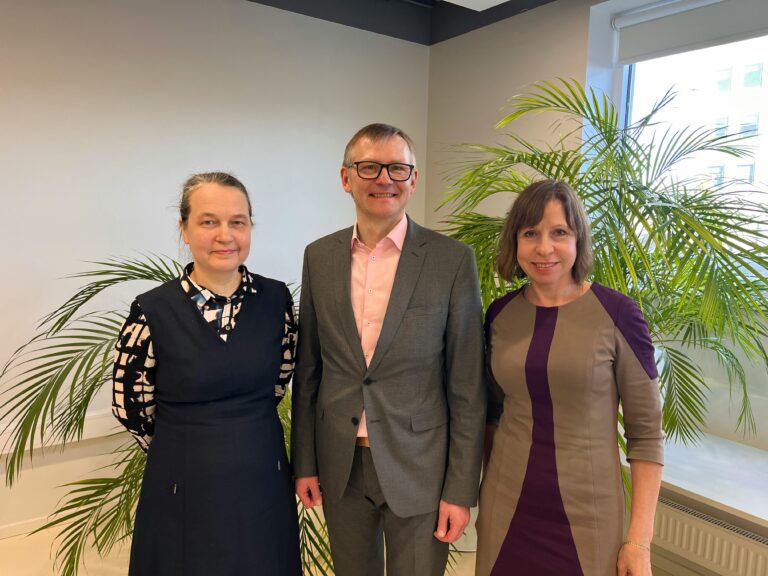
Photo, from left: Jaanika Sass, Ain Aaviksoo, and Ulla Ilisson (photo: ETTOL)