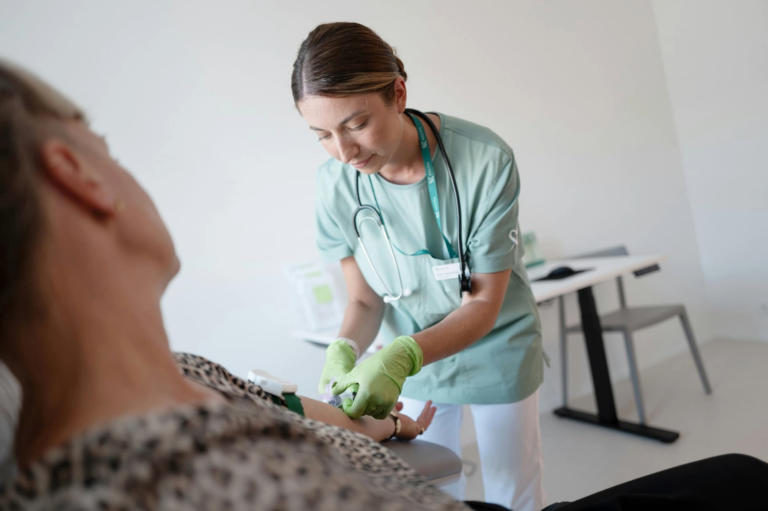
Occupational health examinations
Occupational health examinations provide an overview of an employee’s health and offer recommendations for maintaining wellbeing at work. They help prevent health problems, reduce sickness absence and support a safe and sustainable working environment.
Text reviewed by:

Business Client Process and Product Manager
Published
Text updated
Why offer this service to employees?
Occupational health examinations are not just a legal requirement – they are an effective way to identify health risks early, maintain employee work ability and reduce the costs associated with sickness absence.
Occupational health examinations are part of a comprehensive occupational health system, and the results can be used to plan further activities such as risk assessments, workplace interventions and employee health programmes.
Occupational health examinations:
- Support compliance with occupational health and safety requirements
- Help identify health risks before symptoms become more severe
- Reduce the risk of sickness absence and long-term work disability
- Provide employers with valuable insights for improving working conditions
- Increase employees’ sense of safety and trust in their employer
- Help guide employees to further treatment, consultations or examinations when needed
When is the service needed?
-
Employee health complaints
Employees report back, neck, or shoulder pain. Fatigue and concentration difficulties have become more common. -
Employee returns to work
Employees are returning to work after a prolonged period of illness. -
Hazards present
Employees are exposed to physical, chemical, or ergonomic hazards. -
Prevention
You want to prevent work-related health risks and workplace accidents. -
Risk factors present
The workplace involves noise, vibration, dust, or other measurable risk factors.
What’s included
We offer occupational health examinations tailored to workplace risks, employee needs and regulatory requirements. More comprehensive health audit packages place additional focus on the early detection of common health conditions, including cardiovascular diseases and certain types of cancer.
With Meliva, you can manage occupational health examinations and employee data through a self-service portal, integrate the portal with your employee register
The content of the examination depends on workplace risk factors and may include:
- Consultation with an occupational health physician
- Assessment of health information and working conditions
- Diagnostic tests and examinations (e.g. vision, hearing and blood pressure assessments)
- Referrals for additional examinations when necessary
Based on the results, the physician provides an assessment of the employee’s work ability and recommendations for the employer.
We also provide specialised occupational health examinations and certificates for:
- Seafarers (initial and periodic medical certificates; excluding Norway and the Netherlands)
- Aviation personnel (Class 1, Class 2, LAPL, Class 3 and Cabin Crew medical certificates)
- Security personnel
- Divers
- Blasters and pyrotechnicians
- Rescue workers
- Firearm licence applicants (a prior psychiatric assessment is required and that cannot be obtained from Meliva)
- Read more about maritime medical examinations here (hüperlink teenuslehele).
- Read more about aviation medical examinations here (hüperlink teenuslehele).
How it works
Submit an enquiry
Contact us via the website form, email us at ariklient@meliva.ee, or get in touch with your account manager.
Employee list and risk assessment review
We determine the scope of occupational health examinations based on job roles and workplace risk factors.
Appointment scheduling
Employees can book appointments themselves, or we can organise appointments centrally.
Occupational health examinations
Employees attend the examination and any required tests or assessments.
Results and recommendations
The occupational health physician provides a work ability assessment and recommendations.
Follow-up actions
When necessary, employees may be referred for additional examinations, specialist consultations or mental health support, and recommendations may be provided to improve working conditions.
Frequently Asked Questions
Do you offer on-site services at the workplace?
Occupational health examinations can also be carried out directly at your workplace. Our mobile health buses are equipped with the necessary medical equipment and operate under a licence issued by the Estonian Health Board.
This solution is particularly suitable for organisations where travelling to a clinic would be time-consuming or impractical.
Benefits of the mobile health buses
- Occupational health examinations can be carried out on-site
- Reduces time away from work
- Particularly suitable for larger teams and manufacturing companies
- Available throughout Estonia, including regions without nearby medical centres
Do you also offer ready-made packages?
Meliva’s occupational health check-up packages have been developed in collaboration with our occupational health physicians and workplace safety engineers. They are based on the most common risk factors found in different working environments. We have created ready-made solutions for office workers, production workers and other employee groups to ensure that employees’ health is assessed according to the nature of their work.
All health check-up packages include health counselling and personalised recommendations to help employees maintain their health and work ability. The scope of examinations and tests depends primarily on workplace risk factors, but most tests required for a general health assessment are included in all our check-up packages.
If your company’s working environment or specific needs require a solution that differs from our standard packages, we can flexibly tailor the content of the health check-up. This ensures that the assessment meets your company’s working conditions and objectives.
Is an occupational health examination mandatory?
Yes. Employers are legally required to arrange occupational health examinations for employees whose work involves health risks. The need for examinations and their frequency depend on workplace risk factors and the nature of the work.
How often should employees attend an occupational health examination?
The frequency depends on workplace risk factors, the employee’s role and the recommendations of the occupational health physician. In most cases, examinations are carried out every 1–3 years, but more frequent assessments may be recommended when necessary.
What does an occupational health examination include?
The content of the examination depends on the employee’s work environment and risk factors. It may include a consultation with an occupational health physician, health assessments, diagnostic tests (such as vision, hearing and blood pressure assessments) and additional examinations when required.
Can occupational health examinations be carried out at our workplace?
Yes. Meliva offers mobile occupational health examinations through fully equipped mobile health units that can visit your workplace.
What happens if health concerns are identified during the examination?
If necessary, employees may be referred for further examinations, specialist consultations or mental health support. Recommendations may also be provided to improve workplace conditions and support employee wellbeing.
How are occupational health examinations organised for larger organisations?
Employees can either book appointments themselves through our self-service portal, or Meliva can coordinate appointments centrally for the entire organization.